
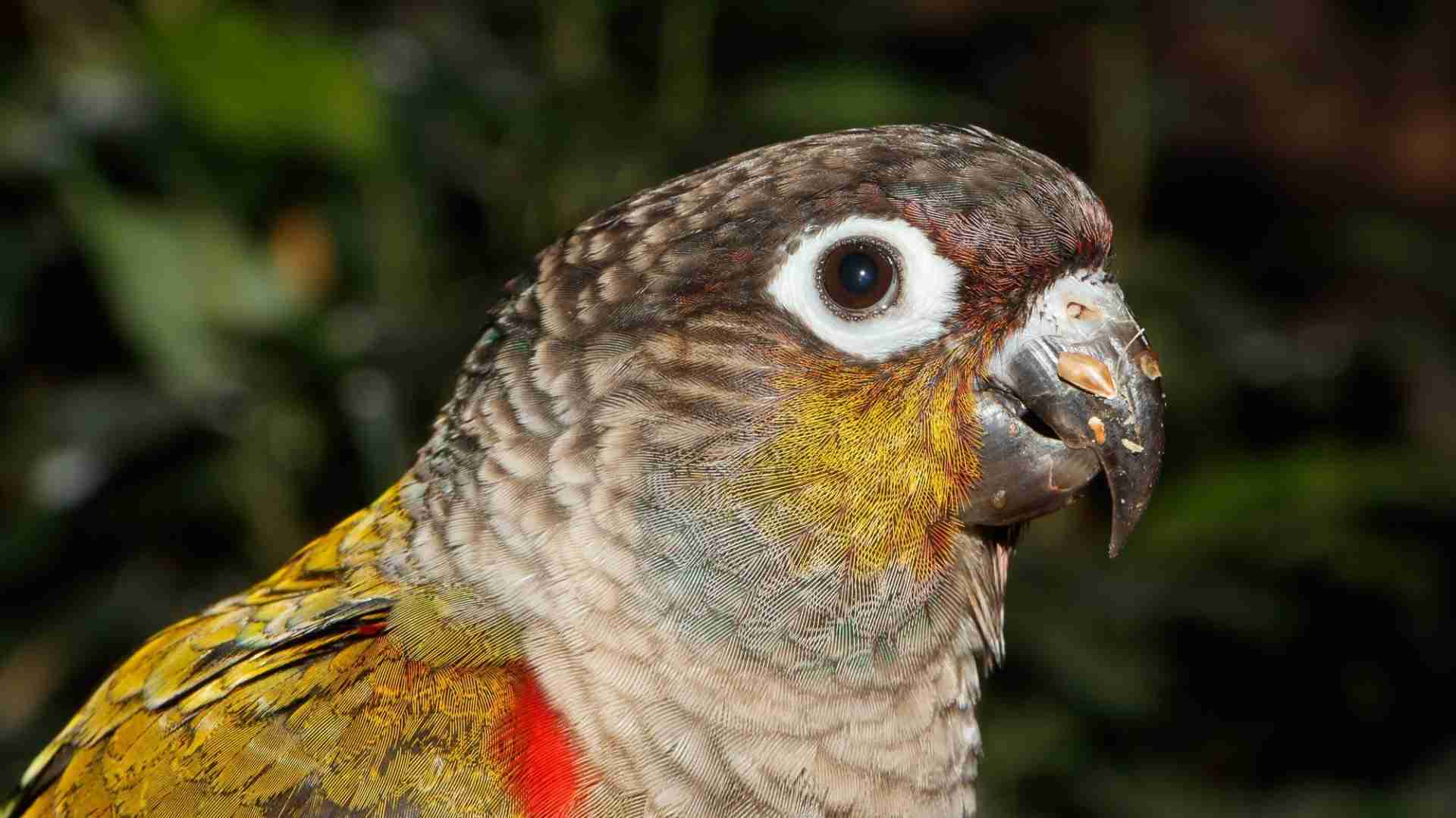
Crimson-bellied Conure
A jewel-toned Pyrrhura conure — small, busy, deeply affectionate, and still one of the rarer beauties in captivity.
Origin
Southern Amazon basin — Brazil and Bolivia, in lowland rainforest and forest edge.
Lifespan
15–25 years
With proper nutrition & care
Size
9–9.5 inches (24 cm)
85–94 g (3–3.3 oz)
Quick Facts
| Origin | Southern Amazon basin — Brazil and Bolivia, in lowland rainforest and forest edge. |
|---|---|
| Size | 9–9.5 inches (24 cm) |
| Weight | 85–94 g (3–3.3 oz) |
| Lifespan | 15–25 years |
| Care level | Intermediate |
| Noise level | Modest for a conure — sharp contact calls and chattering rather than sustained screams. Manageable in most apartments with care. |
| Talking ability | Minimal. The occasional word or household sound, but not a talking species. Choose for temperament, not vocabulary. |
| Beginner-friendly | 4/10 |
The Bird
Crimson-bellied Conure at a Glance
The Crimson-bellied Conure (Pyrrhura perlata) is, to my eye, the most beautiful Pyrrhura in aviculture. The signature crimson-red abdomen against a finely scalloped breast and bright green wings is one of those colour combinations that has to be seen in person — photographs never quite catch it. They are small, around 24 cm and 85–94 g, and they are still relatively rare in captivity, which is part of why I prize them so highly here at Parrot Bliss.
In the wild they are endemic to the southern Amazon basin, ranging across parts of Brazil and Bolivia in lowland rainforest and forest edge. They are listed as Least Concern with a decreasing trend on CITES Appendix II — not yet in trouble, but a species whose captive lines we have a responsibility to keep clean and healthy. The bird you see at maturity is not the bird you see at fledging: juveniles are predominantly green-chested and only develop the full crimson belly as they mature, which catches a lot of new owners off guard.
I place very few Crimson-bellied each year, and I am deliberate about who they go to. They want a keeper who is genuinely interested in the species, who is prepared for a small, busy, deeply social bird, and who understands that "rare in captivity" means thinner husbandry literature and less margin for error than a Green-cheeked or a Sun. If you have kept a Pyrrhura before and you are ready for the prettier, slightly more demanding cousin, this is your bird.
Crimson-bellied Conures are classic Pyrrhura through and through — affectionate, mischievous, fiercely playful, and prone to bonding hard with their people. They are physical birds. Mine spend their out-of-cage time rolled on their backs in my palm, wrestling fingers, hanging upside-down from a play stand, or stuffed under a collar like a pocket pet. The cuddliness is real, and they are surprisingly tolerant of multiple household members when they have been socialised properly from weaning.
What sets them apart from the more common Pyrrhuras is, in my experience, a slightly more reserved baseline. Where a Green-cheek will dive into chaos head-first, a Crimson-bellied will pause, watch, and decide. That makes them a touch easier to live with around children and other pets — provided supervision is always there — but it also means they need a confident, gentle hand during early training. Pushing too hard during a hesitation will set you back weeks.
They have a strong nesting drive in season, and unpaired hens can become hormonal and territorial around perceived nest sites in the cage — fleece tents, hideaway huts, food bowls. Manage daylight hours, restrict shadowy nooks during spring, and respect the fact that even the gentlest Pyrrhura will defend a perceived nest. Bonded pairs are gorgeous to watch but will largely lose interest in you, so decide what you want from the bird before you commit.
Vocalization & Talking
Compared to a Sun or a Blue-crowned, the Crimson-bellied is a quiet bird. The contact call is sharp and chattering, with bursts of soft murmurs and trills throughout the day, but they do not produce the sustained piercing screams that make larger conures incompatible with apartment life. I rate them around a 4 out of 10 on noise — louder than a Lineolated, considerably softer than a Sun.
Talking ability is minimal. A handful of Crimson-bellied I have placed have picked up one or two words and a few household sounds — a microwave beep, the kettle, a wolf-whistle — but most do not speak at all. Score them a 2 out of 10 on talking. If words are what you want, choose almost any other species; choose the Crimson-bellied for its temperament and its looks.
For apartment dwellers and people with shared walls, a single Crimson-bellied is genuinely manageable. A bonded pair roughly doubles the volume because they call to each other constantly, so for noise-sensitive households I steer pair buyers toward a dedicated bird room or detached property. Covering the cage at night for 10–12 hours of dark, quiet sleep does a great deal to control the dawn chorus.
Diet
I wean every Crimson-bellied chick onto a high-quality pelleted base — Harrison's is what I use, with TOPs and Roudybush as the two formulations I will recommend if a family wants to switch. Pellets should make up roughly 60–70% of the daily intake. A seed-based diet in a bird this small is the most reliable way I know to shorten its life — fatty liver disease, vitamin A deficiency, and chronic feather problems all track straight back to seed-heavy keeping.
The remaining 30–40% is fresh produce. Dark leafy greens (kale, dandelion, chard), red and orange vegetables (capsicum, carrot, sweet potato), broccoli florets, cooked sweet potato, sprouted pulses, fresh corn, and small amounts of fruit such as berries, papaya, mango, and apple (seeds removed). A little egg food during moult or breeding is fine. Avocado, chocolate, caffeine, alcohol, onion, garlic, and salty or fried foods are off the menu — strictly, no exceptions.
Seed has its place as a training treat and a foraging tool, never as a meal. Millet spray and small amounts of safflower work well for stepping-up practice and stuffed inside foraging puzzles. In the wild, Crimson-bellied are noted for geophagy — eating clay at exposed riverbanks to neutralise plant toxins and supplement minerals — but in captivity a balanced pellet diet plus a cuttlebone and mineral block covers the same need without the dietary risks.
Health & Lifespan
Crimson-bellied Conures are hardy little birds when their husbandry is right, but the comparatively narrow captive gene pool means a handful of conditions deserve closer attention than usual. Establish a relationship with a board-certified avian vet before your bird comes home, not after the first crisis.
- Psittacine Beak and Feather Disease (PBFD) — viral and incurable; especially worth screening for in a species with limited unrelated lines. Always ask your breeder for current PBFD test results.
- Feather-destructive behaviour — almost always rooted in stress, boredom, or a pair-bond breakdown rather than a primary medical cause; addressed with enrichment, foraging, and stable routine.
- Polyomavirus and Psittacosis (chlamydiosis) — both worth ruling out in any newly purchased bird; psittacosis is zoonotic and treatable when caught early.
- Hypocalcaemia and metabolic bone disease — driven by a lack of UVB exposure; full-spectrum lighting is a husbandry essential, not a luxury.
- Bacterial and fungal gut infections — usually secondary to damp housing, dirty bowls, or stress; routine faecal panels catch them early.
Annual wellness exams with an avian-certified vet are the single best investment you can make in this bird's longevity. Find a member of the Association of Avian Veterinarians (AAV) in your area before you bring the bird home, and use them.
Housing
A single Crimson-bellied or a bonded pair does best in a cage of at least 24 x 18 x 24 inches with 1/2 inch bar spacing. Bigger is better — these are flying birds, not ornaments, and they need horizontal space far more than vertical height. Stainless steel is what I recommend; powder-coated is acceptable from a reputable manufacturer, but never the cheap painted cages that chip and leach metal under a busy beak.
Inside, I want to see at least three perches of varied diameters and materials — natural wood branches (apple, willow, Java, manzanita) of different thicknesses, plus a pumice or cement perch for nail conditioning. Skip the dowel rods that come standard with most cages; they wear pressure points into the foot and contribute to bumblefoot over years. Toys rotate weekly, with a heavy emphasis on shreddable material — palm leaf, balsa, vegetable-tanned leather, untreated paper. Crimson-bellied are vigorous chewers and will redirect onto their own feathers if there is nothing else to demolish.
Out-of-cage time is non-negotiable — two to three hours daily on a play stand or in a parrot-proofed room. Cover the cage at night for 10–12 hours of dark sleep, mist or shower the bird two or three times a week (these are tropical birds and dry indoor air shows up fast in feather quality), and keep them well clear of any kitchen running non-stick cookware. PTFE fumes will kill a conure in minutes.

Frequently Asked Questions
- Are Crimson-bellied Conures rarer than Green-cheeked Conures?
Yes, considerably. Green-cheeks are one of the most established companion conures in the trade, with broad captive lines and easy availability. Crimson-bellied are still relatively uncommon, prices are higher, and the captive gene pool is narrower. That rarity is part of why I am careful about who I place them with — there are simply fewer experienced Crimson-bellied keepers around to lean on if something goes wrong.
- Why is my young Crimson-bellied not red on the belly yet?
Because they are not supposed to be. Juveniles are predominantly green on the chest and belly and only develop the full crimson abdomen as they mature, usually over the first year to eighteen months. Plenty of new owners panic that they have been sold a hybrid or a sick bird; they have not. Photograph the chest at four-month intervals and you will see the colour come in.
- Are they good for an apartment?
A single Crimson-bellied is one of the more apartment-friendly conures, yes. Their contact call is sharp but brief, and their everyday chatter is well below conure-screaming territory. The honest caveat is the contact call when separated from a person they have bonded to — it is piercing and they will repeat it. Most considerate apartment dwellers do fine; very thin walls and very light sleepers might not.
- Can I keep a single Crimson-bellied or do they need a pair?
Either works, but the outcome is very different. A single hand-raised bird with daily out-of-cage time bonds intensely to its person and makes a wonderful shoulder companion. A bonded pair will bond to each other and largely ignore you — beautiful to watch, low maintenance socially, but not a tame pet. Decide what you want before you buy, because re-taming a paired bird is essentially impossible.
- What should I look for when buying a Crimson-bellied Conure?
Ask for current PBFD and Polyomavirus screening, recent faecal results, and the bird's diet history so you can keep it consistent through the move. The bird should be bright-eyed, with clean vent feathers and confident step-up behaviour, and weaned onto a proper pellet base — not a seed mix. A reputable breeder will ask you as many questions as you ask them; if they do not, walk away.
Looking for a hand-raised Crimson-bellied Conure?
Parrot Bliss places a small number of Crimson-bellied Conures each year in West Palm Beach, Florida — hand-fed, weaned onto Harrison's pellets, and placed only with keepers who understand the species' rarity, social needs, and 15–25 year commitment. Contact Kalyn to discuss availability.