
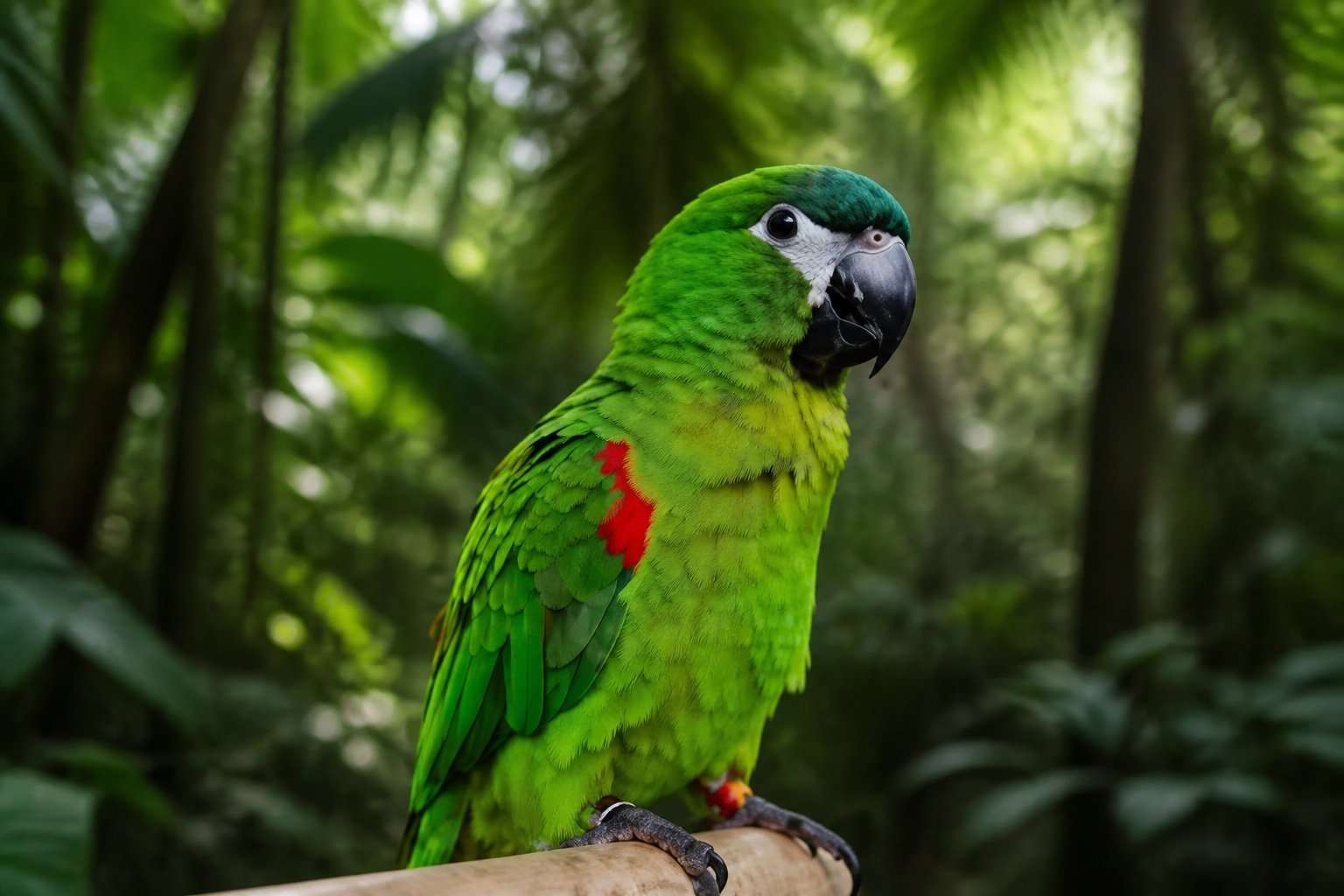
Hahn’s Macaw
The smallest true macaw — full macaw personality, talking ability, and bond in a 12-inch, apartment-compatible package
Origin
Northern South America (Venezuela, Guyana, Trinidad, northern Brazil)
Lifespan
30–35 years
With proper nutrition & care
Size
12 inches (30 cm)
160–175 g (5.6–6.2 oz)
Quick Facts
| Origin | Northern South America (Venezuela, Guyana, Trinidad, northern Brazil) |
|---|---|
| Size | 12 inches (30 cm) |
| Weight | 160–175 g (5.6–6.2 oz) |
| Lifespan | 30–35 years |
| Care level | Intermediate |
| Noise level | Moderate to high — sharp contact calls louder than most small parrots but quieter than large macaws. Not suitable for shared-wall apartments. |
| Talking ability | Good — most Hahn's Macaws develop 20–40 clear words and phrases. One of the strongest talkers relative to size in aviculture. Voice is small but intelligible. |
| Beginner-friendly | 5/10 |
The Bird
Hahn’s Macaw at a Glance
The Hahn's Macaw (Diopsittaca nobilis, also spelled Hans Macaw and known formally as the Red-shouldered Macaw) is the smallest true macaw in the world — 12 inches nose to tail, 165 grams, with the same compact barrel chest, bare facial patch, and macaw attitude compressed into a body you can actually hold in one hand. Native to the savannas and open woodlands of northern South America — Venezuela, Guyana, Trinidad, and the northern fringe of Brazil — Hahn's Macaws move through the wild in noisy, fast-moving flocks. The pet trade has labelled them the starter macaw for thirty years, and Kalyn at Parrot Bliss pushes back on that label every week.
The "starter macaw" reputation is partly deserved. Hahn's are meaningfully more manageable than Blue-and-Golds or Scarlet Macaws — quieter than large macaws, smaller cage footprint, considerably lower food cost, and a talking ability that rivals species twice their size. But starter implies forgiving, and a Hahn's Macaw is not forgiving. The bite breaks skin on adult hands. Sexual maturity at two to three years brings hormonal behaviour that surprises unprepared owners. The chewing drive requires a serious enrichment budget. Kalyn rates them intermediate, not beginner.
What a Hahn's gives an experienced owner is a fully expressive macaw experience scaled to an apartment-compatible footprint. They bond deeply, talk clearly, and perform the whole theatrical macaw repertoire — wing displays, alarm calls, foraging acrobatics — in a package that does not require a dedicated bird room. For the right owner, they are one of the most rewarding species Kalyn places. The right owner just needs to have done the reading first.
Hahn's Macaws are routine-dependent in a way that is more pronounced than most small parrots. They notice when feeding happens later than usual, notice when their cage cover comes off at a different time, and notice when a family member who is normally home at 5pm doesn't appear by 6. That sensitivity translates into a deeply bonded companion for owners with consistent schedules — and into a noisy, anxious, bite-prone bird for owners whose lives are unpredictable. Kalyn asks every prospective Hahn's buyer to walk her through a typical Tuesday before a deposit is discussed.
Cuddliness is genuine — Kalyn rates it a 9 out of 10. Hahn's are physically affectionate, active lap birds, and strong bonders. They typically attach to one or two people in the household and can become territorial toward others if everyone in the home doesn't share handling duties from the beginning. The social score is 6 out of 10, reflecting an independent streak that is more pronounced in this species than in larger macaws — a Hahn's that is tired of being handled will say so clearly, and the bite is not a bluff.
Sexual maturity between two and three years is the period that separates the buyers who did their homework from those who didn't. Hormonal Hahn's become bluffier, nipier, and more territorial around the cage for weeks to months at a time. Kalyn coaches every buyer on bluff management — consistent step-up requests, maintaining regular handling, not escalating when the bird bluffs, and recognising the difference between a bluff display and genuine aggression. Owners who respond to bluffing by backing away end up with a bird that bites to control every interaction within six months.
Vocalization & Talking
Hahn's Macaws score 7 out of 10 for noise. They are meaningfully quieter than large macaws — no room-shaking screams, no flock-call that carries across the neighbourhood — but they are louder than most small parrots. The contact call is a sharp, repeated squawk that will carry through interior walls and wake a light sleeper. Dawn and dusk are the peak noise windows, and a bored or under-stimulated Hahn's will add screaming sessions throughout the day. Apartment dwellers with shared walls should hear an adult Hahn's in person before committing.
Talking is where the Hahn's Macaw genuinely outperforms expectations. Kalyn rates them 7 out of 10 — well-socialised birds typically develop vocabularies of 20–40 words or phrases, some individuals exceeding that considerably. The voice is a small, slightly raspy macaw voice — not the booming clarity of a large Grey, but clear enough to be understood across a room. Hahn's also whistle, mimic environmental sounds, and learn contextual speech — using specific words for specific situations — more consistently than conures or small Poicephalus. For the buyer who wants a talking bird in a smaller package, the Hahn's is one of the strongest options Kalyn has available.
Diet
Kalyn feeds her Hahn's Macaws a pellet-based diet — Harrison's Adult Lifetime Fine or Roudybush Maintenance Small, making up 60–70% of daily intake. The remainder is fresh produce: dark leafy greens, bell pepper, broccoli, carrot, sweet potato, cooked legumes, and sprouted seeds. Fruit is kept to a small portion — Hahn's love papaya, mango, and berries but sugar-rich foods should not dominate the fresh portion. Avocado, chocolate, caffeine, onion, and garlic are toxic and off-limits.
Seeds and nuts are training treats. Pine nuts, almonds, and cashews are high-value rewards that Kalyn uses for step-up, recall, and trick training. A few seeds and a half-nut daily will not unbalance a pellet-based diet; a bowl of mixed seed as the primary food will — seed-fed Hahn's Macaws develop fatty liver disease, poor feather quality, and selective-eating habits that make dietary correction difficult. Kalyn refuses to place birds with buyers who insist on seed as the diet foundation.
Budget is a real conversation Kalyn has with every Hahn's buyer. Ongoing costs run approximately $80–150 per month for a single Hahn's: pellets, fresh produce, supplements, and the chewing budget. Hahn's are serious chewers and their toys do not last long. Kalyn budgets $30–60 per month for enrichment and chewing materials for a well-stimulated bird — cork slabs, balsa blocks, palm leaf foragers, and hardwood perches. Buyers who are not prepared for that ongoing cost should look at a quieter, less destructive species.
Health & Lifespan
A well-cared-for Hahn's Macaw lives 30–35 years. The species is robust, but several conditions warrant specific attention.
- Psittacine Beak and Feather Disease (PBFD) — a viral disease that is particularly severe in macaws. Parrot Bliss tests all birds before placement; buyers should ask for documentation from any source.
- Proventricular Dilatation Disease (PDD) — a neurological/digestive viral disease affecting the enteric nervous system. Rare but serious; rigorous quarantine of incoming birds reduces transmission.
- Chlamydiosis (Psittacosis) — bacterial infection transmissible to humans. Routine screening is part of Parrot Bliss placement protocol.
- Fatty liver disease — diet-driven and entirely preventable with a pellet-based diet and regular exercise. Seed-fed birds are significantly more vulnerable.
- Feather-destructive behaviour — boredom, under-stimulation, hormonal frustration, and inadequate social contact are the most common triggers in this species.
Kalyn recommends an avian vet check within 30 days of placement and annual wellness exams thereafter. Bloodwork starting at age seven helps catch metabolic changes before they become clinical. A Hahn's Macaw that sits unusually still, loses appetite, or changes dropping consistency is showing symptoms — these birds are prey animals and hide illness. Find a certified avian specialist at the Association of Avian Veterinarians.
Housing
For a single Hahn's Macaw, Kalyn recommends a minimum cage of 24 x 24 x 36 inches with 5/8 to 3/4 inch bar spacing. Bigger is better — Hahn's Macaws are active, acrobatic birds that use vertical space constantly. Stainless steel is the gold standard; powder-coated cages are acceptable if the coating is intact. Natural wood perches of varying diameters are essential for foot health; sandpaper perch covers cause abrasion injuries and are not acceptable.
Out-of-cage time is non-negotiable: a minimum of 3–4 hours daily on a play stand or macaw gym in a parrot-proofed room. Hahn's chew continuously and will damage trim, furniture, and window frames given the opportunity. A dedicated play stand with rotating shreddable toys, foraging puzzles, and chewing materials keeps the destruction focused. Kalyn also builds in daily training sessions — 10–15 minutes of target training, step-up drills, and trick reinforcement keeps the Hahn's mentally engaged and the owner-bird relationship in balance.
Cage placement away from the kitchen (Teflon fumes are lethal), away from draughts, and in an active part of the home is Kalyn's standard placement advice. Covering the cage for 10–12 hours of dark, quiet sleep prevents the hormonal irritability that comes from sleep-deprived macaws. Out-of-cage time should be at roughly the same time each day — remember that routine dependency.
Frequently Asked Questions
- Is a Hahn's Macaw really a beginner bird?
Kalyn rates them 5 out of 10 for beginner friendliness — workable with preparation, but not a beginner bird in the way a budgie or a cockatiel is. The bite breaks skin. Sexual maturity at 2-3 years brings hormonal behaviour that surprises unprepared owners. The chewing budget is real and ongoing. The routine dependency means the bird needs a consistent daily schedule, not a chaotic one. A first-time parrot owner who has done serious research, has time for daily training sessions, and is honest with themselves about their schedule can succeed with a Hahn's. A first-time owner who wants a laid-back companion that forgives mistakes will have a hard time.
- How much does a Hahn's Macaw really cost to keep?
Kalyn estimates $80-150 per month for a single Hahn's in Florida — higher than most small parrot species because of the chewing materials and enrichment they need. Harrison's or Roudybush pellets for a 165-gram bird run about $20-30 per month. Fresh produce adds $20-40 depending on your market. Chewing toys, foraging materials, and enrichment items — cork slabs, balsa blocks, palm fronds, hardwood perches — add another $30-60 per month if you're doing it right. Annual avian vet check adds to the yearly total. Budget before you buy, not after.
- How do Hahn's Macaws compare to Conures for talking?
Hahn's are stronger talkers than any conure Kalyn places. Green-cheeked Conures score 3-4 out of 10; Nandays and Sun Conures score 5. Hahn's score 7, and well-socialised individuals routinely develop 20-40 words or short phrases with a voice that's clear enough to understand from across the room. They also tend to use vocabulary more contextually than conures — specific words for specific situations — which gives the impression of real communication rather than just repeating sounds. If talking is a priority and you want a smaller bird, the Hahn's is the strongest option in the small-to-medium range.
- What does 'bluffing' mean and how do I handle it?
Bluffing is the term for the hormonal territorial behaviour Hahn's (and all macaws) go through at sexual maturity, typically between 2-3 years. The bird puffs up, fans its tail, bobs its head, and may lunge or bite during what were previously routine interactions. It is not permanent aggression — it's the macaw equivalent of adolescence. Kalyn's approach: don't back down, don't escalate. Continue asking for step-up calmly and consistently. If the bird bites, say nothing, place it on its perch, and leave for 60 seconds. Return and ask again. Macaws that learn biting terminates interactions stop biting as a control strategy. Macaws whose owners back away learn that bluffing works, and the behaviour intensifies. This is the period that separates the buyers who prepared from those who didn't.
- Are Hahn's Macaws good apartment birds?
Conditionally. They are meaningfully quieter than Blue-and-Golds, Military Macaws, or Scarlet Macaws, and their smaller cage footprint makes the living situation more manageable. Kalyn has placed Hahn's in apartments successfully with owners who were honest about their setup — concrete and brick buildings with no shared bedroom walls, owners who are home most of the day, and neighbours who have been warned. What she will not do is place a Hahn's in a thin-walled apartment building and tell the buyer it will be fine. The contact call is a sharp squawk that carries. Hear one in person before deciding.
Looking for a hand-raised Hahn's Macaw?
Parrot Bliss raises hand-fed Hahn's Macaws in West Palm Beach, Florida — weaned onto Harrison's pellets, socialised for step-up and handling from day one. Kalyn places Hahn's only with intermediate-or-above owners who understand the chewing, the bite, and the routine dependency. Contact Kalyn to discuss availability.