
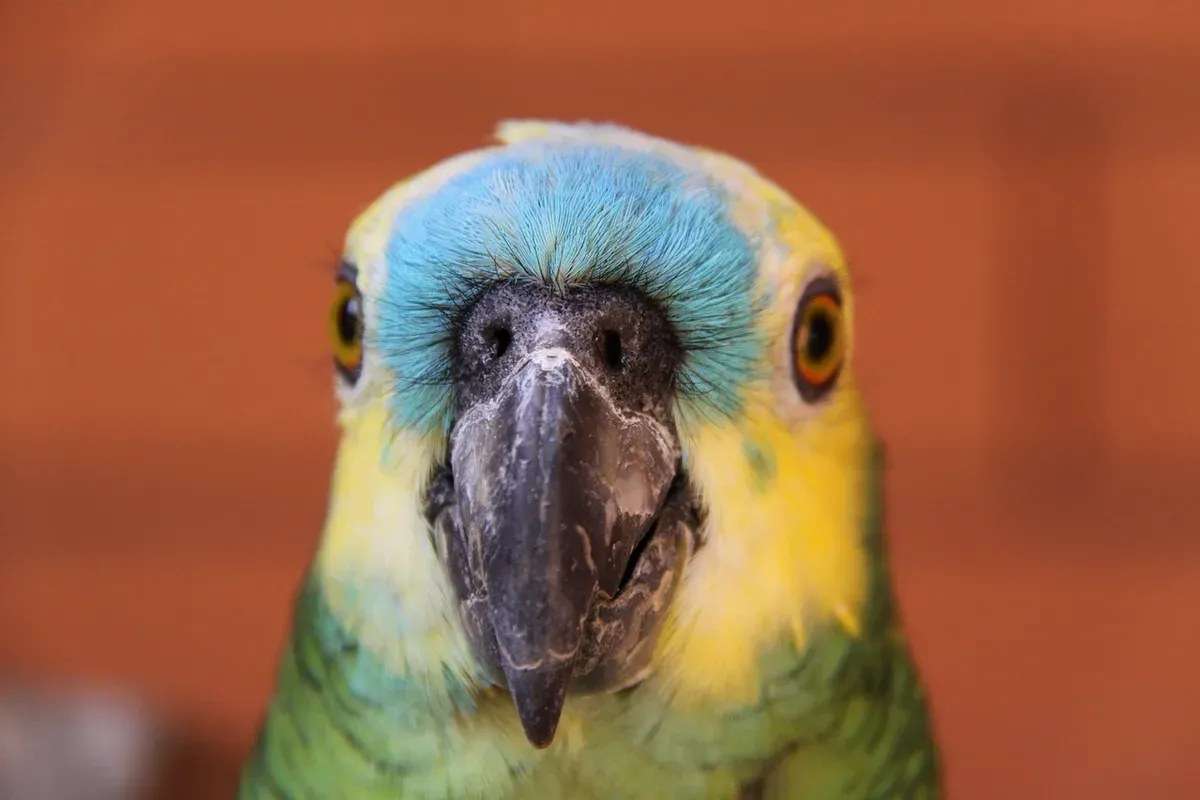
Blue-fronted Amazon
A bold, talkative Amazon with a striking blue brow and a personality that fills the room.
Origin
Central South America — Brazil, Bolivia, Paraguay, and northern Argentina
Lifespan
50–80 years
With proper nutrition & care
Size
14–15 inches (36–38 cm)
400–500 g
Quick Facts
| Origin | Central South America — Brazil, Bolivia, Paraguay, and northern Argentina |
|---|---|
| Size | 14–15 inches (36–38 cm) |
| Weight | 400–500 g |
| Lifespan | 50–80 years |
| Care level | Intermediate |
| Noise level | Loud and carrying, with enthusiastic dawn and dusk vocal sessions. Slightly less piercing than a Yellow-naped, but still not a apartment-share parrot. |
| Talking ability | A genuinely good talker with a clear, often theatrical voice. Many learn songs, whistled tunes, and full phrases, though they sit a notch below the Yellow-naped and Double Yellow-headed in clarity. |
| Beginner-friendly | 4/10 |
The Bird
Blue-fronted Amazon at a Glance
The Blue-fronted Amazon (Amazona aestiva) is one of the most recognizable and beloved Amazons in aviculture, native to the woodlands and savannahs of central South America — Brazil, Bolivia, Paraguay, and northern Argentina. Listed on CITES Appendix II, the species has long been admired for its bold green plumage, distinctive blue forehead patch, and variable yellow markings around the face. Two subspecies are commonly recognized: the nominate A. a. aestiva, which carries less yellow, and A. a. xanthopteryx, which shows more yellow on the face and at the bend of the wing.
At our West Palm Beach aviary, Kalyn has raised Blue-fronts for many years and considers them one of the most personable medium-large Amazons available today. They are confident, opinionated, and theatrical — the sort of bird that announces itself the moment you walk into the room. With sensible socialization and steady boundaries, a well-raised Blue-front becomes a remarkable family companion.
That said, this is not a starter parrot. Blue-fronts live 50 to 80 years, go through a demanding hormonal phase, and need an owner who understands Amazon body language. Kalyn screens buyers carefully and prefers placing these birds with people who have either kept Amazons before or have done their homework. Done properly, a Blue-front is a once-in-a-lifetime companion.
Blue-fronted Amazons are extroverts. They are playful, curious, and deeply interactive, and they tend to bond with the whole household rather than fixating on a single person — though favorites do emerge. Kalyn's hand-raised babies are confident steppers, eager to explore, and quick to learn the household routine.
The famous Amazon "hot flash" is real in this species. As the bird matures, hormonal surges can produce sudden flares of aggression, pinned eyes, fanned tail, and lunging. In Kalyn's experience, the Blue-front's hormonal phase is generally less severe than the Yellow-naped's, but it is still serious and must be respected. Owners who learn to read the warning signs and back off in those moments rarely get bitten.
Outside of hormonal seasons, Blue-fronts are wonderfully engaging. They enjoy training, foraging puzzles, and music, and many will dance and sing along with the household. They are not as cuddly as a cockatoo, and most prefer shoulder time and head scratches over full-body snuggles — which is exactly how a confident Amazon should behave.
Vocalization & Talking
The Blue-front has a clear, resonant voice and is widely regarded as one of the better Amazon talkers, though just below the Yellow-naped and Double Yellow-headed in sheer clarity. Kalyn has placed birds that learned full songs, whistled melodies, and long context-appropriate phrases. They tend to mimic the voices they hear most often, so a household of singers usually produces a singing parrot.
Volume is the trade-off. Blue-fronts have enthusiastic dawn and dusk flock calls that carry through walls and across gardens. This is normal, healthy Amazon behavior and cannot be trained away — only managed by giving the bird a predictable routine, plenty of enrichment, and an appropriate location in the home.
Owners in apartments or shared housing should think carefully before taking on a Blue-front. In a detached home with tolerant neighbors, the noise is part of the charm; in a terraced apartment, it can become a real problem. Kalyn is candid with prospective buyers about this.
Diet
A balanced Blue-front diet is built on a high-quality formulated pellet making up roughly 60–70% of daily intake. Kalyn feeds and recommends Harrison's, TOPs, or Roudybush, all of which are well-formulated for Amazons and avoid the artificial colors and excess sugars found in cheaper seed-based mixes.
Fresh foods make up the remainder. Dark leafy greens — kale, dandelion, chard, and turnip tops — are particularly important because Amazons are prone to vitamin A deficiency, which damages the respiratory tract and skin over time. Add a rotating mix of vegetables, small amounts of fruit, sprouted pulses, and cooked whole grains. Nuts such as almonds and walnuts are excellent training treats but should be rationed, as Blue-fronts gain weight easily.
Avoid avocado, chocolate, caffeine, alcohol, and salty or fried human food. Fresh water should be changed at least daily, and twice daily in the Florida heat. Kalyn weighs her birds regularly on a gram scale; obesity is one of the most common preventable health problems in pet Amazons, and early weight gain is far easier to correct than fatty liver disease later on.
Health & Lifespan
Blue-fronted Amazons are robust when fed and housed well, but they are susceptible to a handful of conditions every owner should know. An annual wellness exam with an avian vet — including a physical, weight check, and baseline bloodwork — is the single best investment you can make in a 50-to-80-year companion.
- Psittacosis (Chlamydia psittaci) — a zoonotic bacterial infection that can present with respiratory signs, lethargy, and green droppings.
- Aspergillosis — a fungal respiratory disease often linked to poor ventilation, damp bedding, or a weakened immune system.
- Papillomatosis — Amazon-specific cloacal and oral wart-like lesions, associated with Psittacid Herpesvirus and requiring veterinary diagnosis.
- Vitamin A deficiency — common in seed-heavy diets; causes white plaques in the mouth, sinusitis, and chronic respiratory issues.
- Obesity and fatty liver disease — frequent in pet Amazons fed too many seeds, nuts, or table scraps with too little flight time.
Choose a vet who is a member of the Association of Avian Veterinarians (AAV). If anything seems off — fluffed posture, tail-bobbing, changes in droppings, or appetite loss — book an appointment the same day. Parrots hide illness until they cannot, and an early visit often makes the difference.
Housing
The minimum cage for a Blue-fronted Amazon is 36 inches wide by 24 inches deep by 48 inches tall, with 1 to 1.5 inch bar spacing. Bigger is always better, particularly in width — Amazons climb and side-step more than they fly inside the cage. Powder-coated stainless steel is Kalyn's preferred material; avoid zinc and lead in old or imported cages, as both are toxic.
Kit the cage out with at least three or four perches of varying diameters and natural materials — manzanita, java wood, and untreated fruit-tree branches are excellent for foot health. Rotate a generous selection of foraging toys, shreddable wood, and puzzle feeders. A bored Amazon is a screaming, plucking, biting Amazon, so enrichment is not optional.
Plan for at least 3 to 4 hours of supervised out-of-cage time every day on a sturdy play stand. The room should be free of non-stick cookware fumes, scented candles, aerosols, and open windows without screens. With proper housing, a balanced diet, and a household that respects the hormonal seasons, a Blue-front can easily live past 60 in excellent health.


Frequently Asked Questions
- Are Blue-fronted Amazons good for first-time parrot owners?
Honestly, not usually. I rate them a 4 out of 10 for beginners because the hormonal phase catches new owners off guard and the noise level is real. That said, I have placed Blue-fronts with thoughtful first-time owners who did serious homework and committed to working with an avian vet and a behaviourist if needed. If you have kept a smaller parrot well for a few years, a Blue-front can be a beautiful next step. If this is your very first bird, I usually steer people toward something gentler first.
- How well do Blue-fronted Amazons talk?
Very well, in my experience. I rate them a 7 out of 10 — clear, often theatrical, and very fond of songs and whistled tunes. They sit just below the Yellow-naped and Double Yellow-headed in pure clarity, but they make up for it in personality and delivery. Some of my babies have gone home with small vocabularies already started. As always with parrots, talking is a bonus, never a guarantee — never buy any bird purely for its voice.
- What is the Amazon "hot flash" and how bad is it in Blue-fronts?
It is the burst of hormonal aggression that mature Amazons go through, especially in spring. You will see pinned eyes, a fanned tail, raised neck feathers, and sudden lunges. In Blue-fronts I find it generally less severe than in Yellow-napes, but it is still serious and every owner needs to learn the body language. The trick is to read the warnings, give the bird space, and never punish — work with the season, not against it.
- How long do Blue-fronted Amazons live?
Fifty to eighty years with proper care, which is why I screen buyers so carefully. I have known Blue-fronts in their sixties who are still bright, active, and bonded to their families. That kind of lifespan means you must plan for the bird in your will and ideally identify a successor caregiver early. It is a genuine multi-decade commitment, not a pet you rehome when life gets busy.
- What should I feed my Blue-fronted Amazon day to day?
I feed a base of Harrison's, TOPs, or Roudybush pellets at roughly 60 to 70 percent of the diet, then build the rest from dark leafy greens, fresh vegetables, a little fruit, sprouted pulses, and cooked whole grains. Vitamin A is critical for Amazons, so kale, chard, dandelion, and turnip tops are in heavy rotation here. Nuts are reserved for training treats because Blue-fronts gain weight easily. Always avoid avocado, chocolate, caffeine, alcohol, and salty human food.