
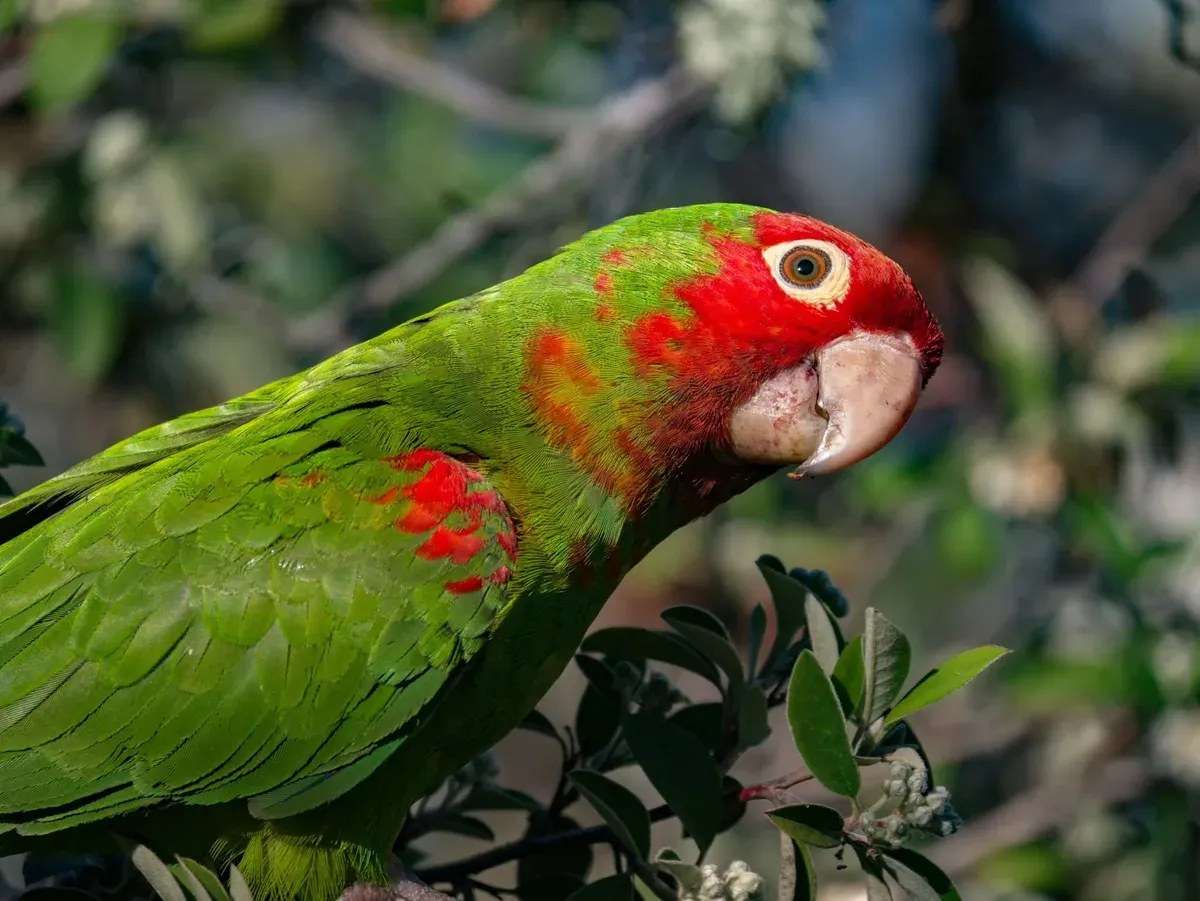
Red-Masked Conure
The bold, talkative star of 'The Wild Parrots of Telegraph Hill'
Origin
Western Ecuador and northwestern Peru
Lifespan
25-30 years
With proper nutrition & care
Size
13 inches (33 cm)
160-200 g (5.6-7 oz)
Quick Facts
| Origin | Western Ecuador and northwestern Peru |
|---|---|
| Size | 13 inches (33 cm) |
| Weight | 160-200 g (5.6-7 oz) |
| Lifespan | 25-30 years |
| Care level | Advanced |
| Noise level | Very loud. Sharp, carrying contact call. Sustained vocalisations at dawn and dusk. Not apartment-suitable. |
| Talking ability | Fair to good. Many learn 10 to 20 words plus household sounds with reasonable clarity. |
| Beginner-friendly | 3/10 |
The Bird
Red-Masked Conure at a Glance
The Red-Masked Conure is the bird made famous by the documentary The Wild Parrots of Telegraph Hill — bright green with a full red head and face, like a green parrot wearing a scarlet mask. At 13 inches and 160 to 200 grams it sits at the larger end of the medium-conure range, with a confident, slightly imposing presence that smaller conures do not have.
Behaviorally, Red-Maskeds are bold, intelligent, and energetic. They are not for shy households. The species reads situations quickly, makes decisions confidently, and is not shy about expressing opinions. Owners who enjoy assertive, interactive parrots find Red-Maskeds rewarding; people looking for a soft, deferential bird usually pick the wrong species and rehome within a year. Like several other large Aratinga conures, Red-Maskeds have established feral flocks in parts of California, Florida, Texas, and beyond — a strong indicator of how adaptable and tough they are.
The honest caution is twofold: noise and bite pressure. Red-Maskeds are loud, with a sharp, carrying call, and they have stronger beaks than smaller conures. Inconsistent handling produces a bird that bites hard. Consistent handling produces a confident, talking, affectionate companion for 25 to 30 years. The difference is entirely in the work the household puts in during the first two years.
Red-Masked Conures are confident, social, and physically active. The species is naturally bold rather than shy — a Red-Masked walks into a new situation expecting to be in charge, and unless the household sets clear rules, it will be. That same boldness produces a bird that is unafraid of household noise, kids, vacuum cleaners, and strangers, which makes them surprisingly resilient compared to more nervous species.
The bonding pattern is stronger than in many medium conures. Red-Maskeds tend to fixate on a primary person and may show jealousy toward other household members during hormonal seasons. The fix is socialization from young — handling by multiple people daily, consistent step-up rules, and no exclusive snuggling with one person to the exclusion of others. Without that work the species becomes a one-person bird that bites everyone else, which is rarely what families want.
The nippy reputation is real. Red-Maskeds bite hard for a bird their size, especially during adolescence and the first hormonal season. They test what they can get away with. Owners who reward biting with reactions or who chase a biting bird across a play stand teach the bird that biting works. Owners who use clear step-up cues, calm body language, and consistent boundaries produce a confident bird that does not bite. The temperament is workable; the work has to be done.
Vocalization & Talking
Red-Masked Conures are very loud. The contact call is sharp, high-frequency, and carries far — in their native range and feral colonies, flocks coordinate over substantial distances using these calls. Indoors, expect sustained vocal sessions at dawn and dusk lasting 15 to 30 minutes, plus shorter outbursts triggered by household excitement, passing dogs, the doorbell, or other birds nearby.
Like most conures, Red-Maskeds are not constant screamers when their needs are met. A well-socialized, well-stimulated bird stays quiet for long stretches mid-day and chatters at conversation level while playing. Reinforcing screams by reacting to them — running into the room, scolding loudly, or covering the cage in response — trains the bird to scream more. The peaks are loud enough that Kalyn does not recommend Red-Maskeds for apartments or townhouses.
On talking, Red-Maskeds are fair-to-good talkers — better than Sun and Jenday conures, comparable to Gold-Capped, not as clear as a Nanday at peak. Many learn 10 to 20 words and a handful of household sounds with reasonable clarity. They also mimic environmental noises (microwave beeps, doorbells, alarm clocks) accurately. Daily short training sessions from a young age produce the best vocabulary.
Diet
Build the daily diet around a high-quality pellet — Harrison's, TOPs, Roudybush, or Zupreem Natural — at 60 to 70 percent of intake. Red-Maskeds adapt well to pellets when introduced from young; older birds raised on seed mixes can be converted with patience over several weeks. Pellets are non-negotiable for long-term health. An all-seed Red-Masked heads toward fatty liver disease, vitamin A deficiency, and a significantly shortened lifespan.
Fresh vegetables make up 20 to 25 percent of daily intake. The best foods are dark leafy greens (kale, Swiss chard, romaine — never iceberg), sweet potato, butternut squash, bell pepper of any color, broccoli florets, carrot, and cooked legumes such as lentils and chickpeas. Rotate the lineup weekly to keep the bird interested. Red-Maskeds are confident foragers and engage strongly with skewers, foraging boxes, and chop bowls — chop coarsely so the bird has to manipulate pieces.
Fresh fruit should be 5 to 10 percent of the diet, kept moderate because of sugar. Berries, apple without seeds, papaya, and melon are good. Nuts and seeds work as training treats only — one almond piece, pine nut, or sunflower seed per repetition of a desired behavior. Red-Maskeds are large enough to enjoy cracking nuts in the shell as scheduled enrichment, but keep portions reasonable. Toxic to all parrots: avocado, chocolate, caffeine, alcohol, onion, garlic, salt, and any food cooked on non-stick cookware.
Health & Lifespan
A Red-Masked Conure with proper care lives 25 to 30 years. Establish a relationship with a board-certified avian vet via the Association of Avian Veterinarians directory within the first month and schedule annual wellness exams. Baseline bloodwork every two to three years catches metabolic issues before they become symptomatic.
The two health issues Kalyn watches for in Red-Maskeds are Psittacine Beak and Feather Disease (PBFD), a viral condition the species is somewhat prone to and which causes feather loss and beak deformity over time; and feather plucking, which is almost always behavioral and tied to boredom, hormonal frustration, or sudden routine changes. PBFD prevention is straightforward: buy from breeders who test their breeding stock, and ask for documented PBFD-negative status before purchase. Plucking prevention is husbandry — daily out-of-cage time, varied enrichment, and a stable routine. Weigh the bird weekly on a kitchen scale to catch weight changes early.
Housing
Minimum cage dimensions for a Red-Masked Conure are 24"W x 24"D x 36"H with bar spacing of 5/8 to 3/4 inch. Bigger is always better. A 32"W x 24"D x 38"H flight cage is a much better long-term home for a bird this size. Red-Maskeds are physically active climbers and chewers and need horizontal as well as vertical space.
Equip the cage with three or four perches in varying diameters and textures — natural manzanita, rope, and a flat platform perch all support foot health better than uniform dowels. Stock four to six rotating toys at any time, with shredding material (palm, balsa, soft pine), foot toys, and at least one foraging puzzle. Red-Maskeds have stronger beaks than smaller conures and destroy soft wood quickly, so build the rotation around durable items and replace shred material weekly. Place the cage in a social room — living room or den — well away from the kitchen, because non-stick cookware fumes are acutely fatal to all parrots.
Plan on three to four hours of out-of-cage time daily. Red-Maskeds are physically active and need flight, climbing, and one-on-one engagement to stay mentally healthy. A play stand near where the family spends time, plus supervised free flight in a bird-proofed room, works better than long forced shoulder sessions. Bird-proof carefully: cords, ceiling fans, open windows, toxic plants, and any pet that views birds as prey.


Frequently Asked Questions
- Are Red-Masked Conures the same as Cherry-Headed Conures?
Yes — Red-Masked Conure and Cherry-Headed Conure are two common names for the same species, Psittacara erythrogenys. The 'Cherry-Headed' name is used widely in California, partly because of the documentary 'The Wild Parrots of Telegraph Hill,' which featured the feral San Francisco flock. Both names describe the same bird.
- Do Red-Masked Conures bite?
They can, particularly during adolescence and the first hormonal season. Red-Maskeds are bold, confident birds with strong beaks for their size, and they bite harder than smaller conures. The fix is consistent handling from young — clear step-up cues, no rewarding biting with reactions, and steady boundaries. With proper handling, Red-Maskeds are no nippier than other Aratinga conures.
- Can a Red-Masked Conure live in an apartment?
Kalyn does not recommend it. The contact call is sharp and carries through walls easily, and dawn and dusk vocalisations can last 15 to 30 minutes. Even well-socialized birds will upset close neighbors. Red-Maskeds do best in single-family homes with reasonable buffer space.
- Why does my Red-Masked Conure prefer one person?
The species naturally bonds intensely with a primary handler, and during hormonal seasons that bond can intensify into jealousy toward other household members. The prevention is socialization from young — daily handling by multiple people, no exclusive snuggle sessions, and consistent step-up rules from everyone. An adult bird that has fixated on one person can still be socialized broader, but it takes longer.
- Are Red-Masked Conures susceptible to PBFD?
The species is somewhat prone to Psittacine Beak and Feather Disease, a viral condition that causes feather loss and beak deformity. The simplest prevention is buying from breeders who test their breeding stock and provide documented PBFD-negative status. Ask for that documentation before purchase, and have your avian vet run a baseline screening at the first wellness exam.