
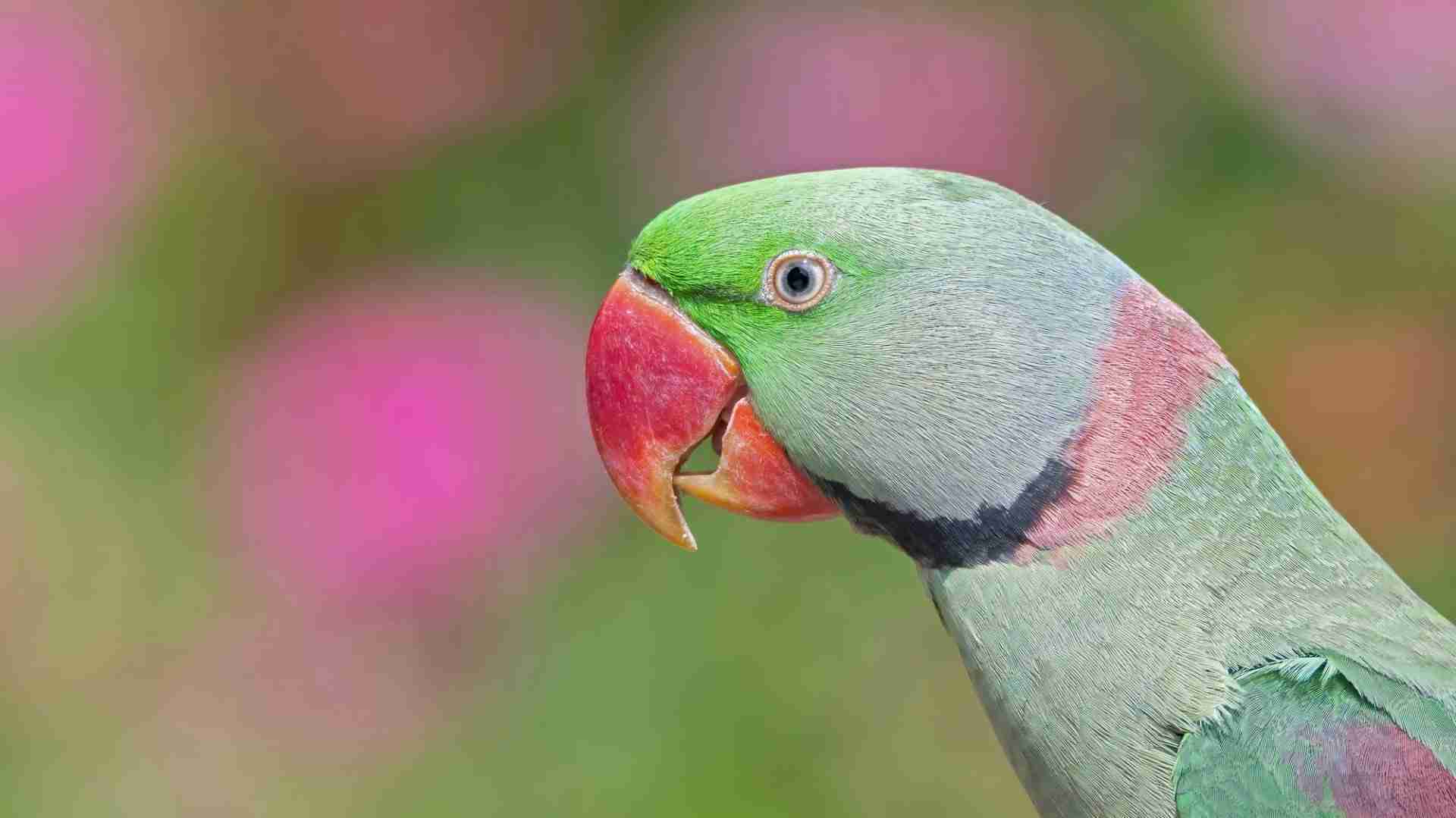
Alexandrine Parakeet
The larger, steadier, more imposing cousin of the Indian Ringneck — a long-tailed Asian parakeet with depth, brains, and a 30-year bond.
Origin
South and Southeast Asia — India, Sri Lanka, Bangladesh, Pakistan, Nepal, Myanmar, Thailand, Laos, Cambodia, and Vietnam, in forest, woodland, and increasingly urban parks.
Lifespan
25–40 years
With proper nutrition & care
Size
22–24 inches (56–62 cm) including tail
200–300 g (7–10.5 oz)
Quick Facts
| Origin | South and Southeast Asia — India, Sri Lanka, Bangladesh, Pakistan, Nepal, Myanmar, Thailand, Laos, Cambodia, and Vietnam, in forest, woodland, and increasingly urban parks. |
|---|---|
| Size | 22–24 inches (56–62 cm) including tail |
| Weight | 200–300 g (7–10.5 oz) |
| Lifespan | 25–40 years |
| Care level | Intermediate |
| Noise level | Vocal but not a screamer — deep rolling contact calls at dawn, dusk, and excitement. Manageable in a detached home; generally too loud for a thin-walled apartment. |
| Talking ability | Strong for a long-tailed parakeet. Most learn 30–70 words and household sounds in a clear, slightly nasal voice — comfortably ahead of cockatiels and budgies on clarity. |
| Beginner-friendly | 4/10 |
The Bird
Alexandrine Parakeet at a Glance
The Alexandrine Parakeet (Psittacula eupatria), also called the Alexandrian Parrot, is the larger, more imposing cousin of the Indian Ringneck and one of my favorite long-tailed parrots to place. They are named for Alexander the Great, who reputedly brought the species west from India in the 4th century BC — making them one of the longest-kept parrots in the European tradition. They look the part: 22–24 inches from beak to tail tip, 200–300 grams of muscle, a deep emerald body, the maroon shoulder patch that gives them away instantly, and in mature males a striking rose-and-black neck ring.
Their wild range is South and Southeast Asia — India, Sri Lanka, Bangladesh, Pakistan, Nepal, Myanmar, Thailand, Laos, Cambodia, and Vietnam — across forest, woodland, and increasingly urban parks and orchards. They sit on CITES Appendix II and IUCN classifies them as Near Threatened, with wild populations declining largely from habitat loss and the historical pet trade. Modern captive lines are well established and well bred, and every Alexandrine I place is parent-reared or hand-fed from my own flock here in West Palm Beach.
Where the Indian Ringneck is bright, busy, and a touch reactive, the Alexandrine is a noticeably steadier, larger, more deliberate bird. The voice is deeper, the bond runs slower but ultimately stronger, and the lifespan stretches to 25–40 years with proper care. They want a keeper who appreciates a thinking parrot rather than a cuddle-monster, who can handle the bluffing phase that all Psittacula species go through at maturity, and who has the space for a 4-foot wide cage and a serious play stand.
Alexandrines are confident, intelligent, observant birds with a deep loyalty to the people they trust. They are not the cuddly lap-pet that some new owners hope for when they hear "hand-raised parakeet" — they are thinking parrots in the Psittacula tradition, more like a small Greenwing Macaw in disposition than a Senegal or a Conure. They watch the room, weigh the situation, and decide on their own terms when to come and play. That independence is exactly what I love about the species, and it is what makes them so satisfying for the right owner.
Like all Psittacula, they go through a "bluffing" phase between roughly 18 months and three years as they hit sexual maturity. A bird that was easy as a youngster will suddenly start lunging, biting, and refusing to step up — and it catches first-time owners completely off guard. The phase passes within a year if you stay calm, do not punish the behavior, and keep training and handling consistent. I drill this into every new Alexandrine owner before pickup, because it is the single most common reason these birds end up in rescues.
With training, Alexandrines become remarkable companions. They are slower to bond than a smaller parrot but, once trust is established, deeply attached and playful. Hand-raised birds shared across the household tend to be confident with multiple people; birds raised exclusively by one person can become strongly one-person and territorial. Children old enough to handle the size and beak respectfully tend to do well with them, but the bite of a mature Alexandrine is genuinely powerful and not appropriate for small kids.
Vocalization & Talking
Alexandrines are vocal birds, but they are not screamers in the way an Amazon or a Conure can be. The natural call is a deep, rolling “kee-ak” — louder, slower, and considerably more pleasant than the sharp screech of an Indian Ringneck. They use it to greet you, announce visitors, comment on something exciting outside the window, and broadcast their presence at sunrise and sunset. I rate them around a 6 out of 10 on noise — manageable in a detached home with reasonable neighbors, generally too loud for a thin-walled apartment.
Talking ability is genuinely strong for a parakeet. Most Alexandrines I have placed pick up 30 to 70 words and short phrases by their third or fourth year, in a clear, slightly nasal voice that is easier to understand than a Ringneck. They are noted as one of the better talkers in the long-tailed parrot family, comfortably ahead of cockatiels and budgies on clarity even if they fall short of a Grey on vocabulary. They also mimic household sounds enthusiastically — microwave beeps, doorbells, the dog, your laugh.
What I tell new owners: do not buy an Alexandrine for the talking. Buy one because you want a clever, observant, imposing parakeet, and treat any speech as a bonus. Most learning happens between roughly six months and four years, and birds raised in chatty households where their humans narrate the day end up the most verbal. Background radio and quiet repetition work far better than drilling.
Diet
I wean every Alexandrine chick onto a high-quality pelleted base — Harrison's is what I use, with TOPs and Roudybush as the two formulations I will recommend if a family wants to switch. Pellets should make up roughly 60–70% of the daily intake. The classic Alexandrine nutritional disaster is the all-seed diet that the species is unfortunately associated with in older literature — it is high in fat, low in calcium and vitamin A, and over the years it leads directly to obesity, fatty liver disease, atherosclerosis, and chronic feather problems.
The remaining 30–40% is fresh produce. Dark leafy greens (kale, dandelion, chard), red and orange vegetables (capsicum, carrot, sweet potato), broccoli florets, fresh corn on the cob, sprouted pulses, cooked beans and pulses, and small amounts of fruit (berries, apple, pear, papaya, mango, pomegranate). Alexandrines are particularly fond of fresh corn and pomegranate seeds; both make excellent training rewards. Nuts in the shell — a single almond, walnut, or pistachio — are wonderful foraging treats and good beak conditioning.
Avocado, chocolate, caffeine, alcohol, onion, garlic, and salty or fried foods are absolutely off the menu. Fresh, clean water changed at least twice daily — they bathe enthusiastically, dunk food, and a fouled bowl turns into a bacterial problem fast in the Florida heat. A cuttlebone and a mineral block stay in the cage permanently. If you are converting an adult Alexandrine off a seed diet, do it gradually over several weeks, mixing pellets in increasing proportions, and confirm the bird is actually eating before you remove the old food.
Health & Lifespan
Alexandrines are robust, hardy birds when their husbandry is right. I have placed birds that comfortably push past 30 years in well-run homes. The conditions every new owner should recognize are the same ones a board-certified avian vet will screen for at the first wellness exam.
- Polyomavirus and Psittacine Beak and Feather Disease (PBFD) — both worth screening for in any newly purchased bird. PBFD particularly affects long-tailed Asian parakeets and is incurable.
- Aspergillosis — a fungal respiratory infection more common in Florida humidity and in birds kept in damp or poorly ventilated housing. Watch for labored breathing, tail-bobbing, and any change in voice.
- Psittacosis (chlamydiosis) — a zoonotic bacterial infection. Lethargy, fluffed posture, runny droppings, and nasal discharge are all red flags.
- Obesity, fatty liver disease, and atherosclerosis — all driven by seed-heavy diets and insufficient exercise; the most common avoidable cause of premature death in the species.
- Hypocalcaemia and metabolic bone disease — driven by lack of UVB exposure; full-spectrum lighting is essential, particularly indoors.
- Feather-destructive behavior — almost always boredom, anxiety, or routine breakdown rather than a primary medical cause.
Annual wellness exams with a board-certified avian vet are non-negotiable for a 30-year bird. Find a member of the Association of Avian Veterinarians (AAV) in your area before your bird comes home, not after the first emergency.
Housing
Alexandrines are large, long-tailed birds and they need cage space that respects both dimensions. The minimum I will place a single bird into is 36 x 24 x 48 inches with bar spacing of 5/8 to 3/4 inch. Bigger is always better — these are flying parrots, and a flight cage of 48 inches wide or more is a far better fit if the room allows. The tail alone is roughly half the bird's total length, and a cramped cage damages tail feathers fast. Stainless steel is what I recommend; powder-coated is acceptable from a reputable manufacturer, but never the cheap painted cages that chip and leach metal.
Inside, perches matter more than people realize. Three to five perches of varied diameters and materials — natural wood branches (apple, willow, Java, manzanita) of different thicknesses, a rope perch, and a pumice or concrete perch for nail conditioning. Skip the dowel rods that come standard. Toys rotate weekly with a heavy emphasis on shreddable material and foraging puzzles — palm leaf, balsa, vegetable-tanned leather, hardwood blocks, paper-wrap puzzles. Alexandrines are powerful chewers; budget for new toys monthly and source them from reputable parrot-safe manufacturers.
Out-of-cage time is non-negotiable: three to four hours minimum every day, supervised, on a play stand or in a parrot-proofed room. Cover the cage at night for 10–12 hours of dark sleep, mist or shower the bird two or three times a week, and provide full-spectrum UVA/UVB lighting positioned within 12 inches of a perch. Modern window glass filters UVB out, and without it the bird cannot synthesise Vitamin D3 — and a 30-year hypocalcaemia risk is not one I am willing to take with any bird I have raised.
-
Bourke's Parakeet
The quiet, gentle Australian parakeet — one of the…
-

Budgerigar (Budgie)
Australia's pocket-sized polyglot — the most underestimated parrot in…
-

Cockatiel
The gentle, expressive whistler — North America's classic beginner…
-

Blue-Headed Pionus
The calm, quiet medium parrot — an underrated gem…
Frequently Asked Questions
- What is the difference between an Alexandrine Parakeet and an Indian Ringneck?
Size, voice, and temperament. Alexandrines are noticeably larger — 22 to 24 inches with the tail and around 250 grams, versus 16 inches and 110 grams for a Ringneck. The voice is deeper and slower, the temperament is steadier and more deliberate, and the bond tends to run slower but ultimately stronger. The maroon shoulder patch is the instant visual giveaway. Both species go through the bluffing phase, but Alexandrines tend to be a touch more forgiving through it. If you want the personality of a Ringneck in a more imposing, longer-lived bird, the Alexandrine is your pick.
- Are Alexandrines good for a first-time parrot owner?
They can be, with eyes open. I score them a 4 out of 10 on beginner-friendliness — not a pure beginner bird, but accessible to a thoughtful first-time owner who has done their homework. The bluffing phase between 18 months and three years catches new owners completely off guard if they are not warned about it, and the size, voice, and 30-plus year lifespan are real commitments. Cockatiels, budgies, and conures are easier first parrots, but if your heart is set on an Alexandrine and you commit to consistent training, they make wonderful long-term companions.
- What is the bluffing phase and how do I handle it?
Bluffing is the hormonal phase most Psittacula parrots go through as they hit sexual maturity, usually starting around 18 months and finishing somewhere between 30 and 36 months. You will see lunging, bite attempts, cage territoriality, and a general attitude shift in a bird that was easy as a youngster. Stay calm. Do not punish the behavior, do not stop handling the bird, and keep training short and positive. Step-up practice, target work, and positive reinforcement carry you through. Owners who push back hard end up with a permanently fearful bird; owners who quietly persist come out the other side with a wonderful adult.
- How loud is an Alexandrine in a apartment or apartment?
Honestly, too loud for most apartments. Their natural contact call is a deep, rolling 'kee-ak' that carries through walls — nowhere near cockatoo volume, but considerably louder than a cockatiel or a small conure. I rate them about a 6 out of 10 on noise. A detached single-family home with reasonable neighbors is realistic; a thin-walled apartment is asking for noise complaints. Cover the cage at night for 10 to 12 hours of dark, quiet sleep, and that controls the worst of the dawn and dusk calling.
- Will an Alexandrine bond with one person or the whole family?
It depends entirely on early socialization. A bird raised exclusively by one person, fed only by that person, and handled only by that person will become strongly one-person and likely territorial with everyone else. A bird where every adult shares feeding, training, and step-up practice from day one will be confident with the whole household. Hand-raising matters less here than socialization across the family in the first year. I drill this into every new Alexandrine owner before pickup.
Looking for a hand-raised Alexandrine Parakeet?
Parrot Bliss hand-raises Alexandrine Parakeets in West Palm Beach, Florida — weaned onto Harrison's pellets, fully socialized across the household, and placed only with families who understand the bluffing phase, the 30+ year commitment, and the substantial space needs. Contact Kalyn to discuss availability or how an Alexandrine compares to an Indian Ringneck for your home.