
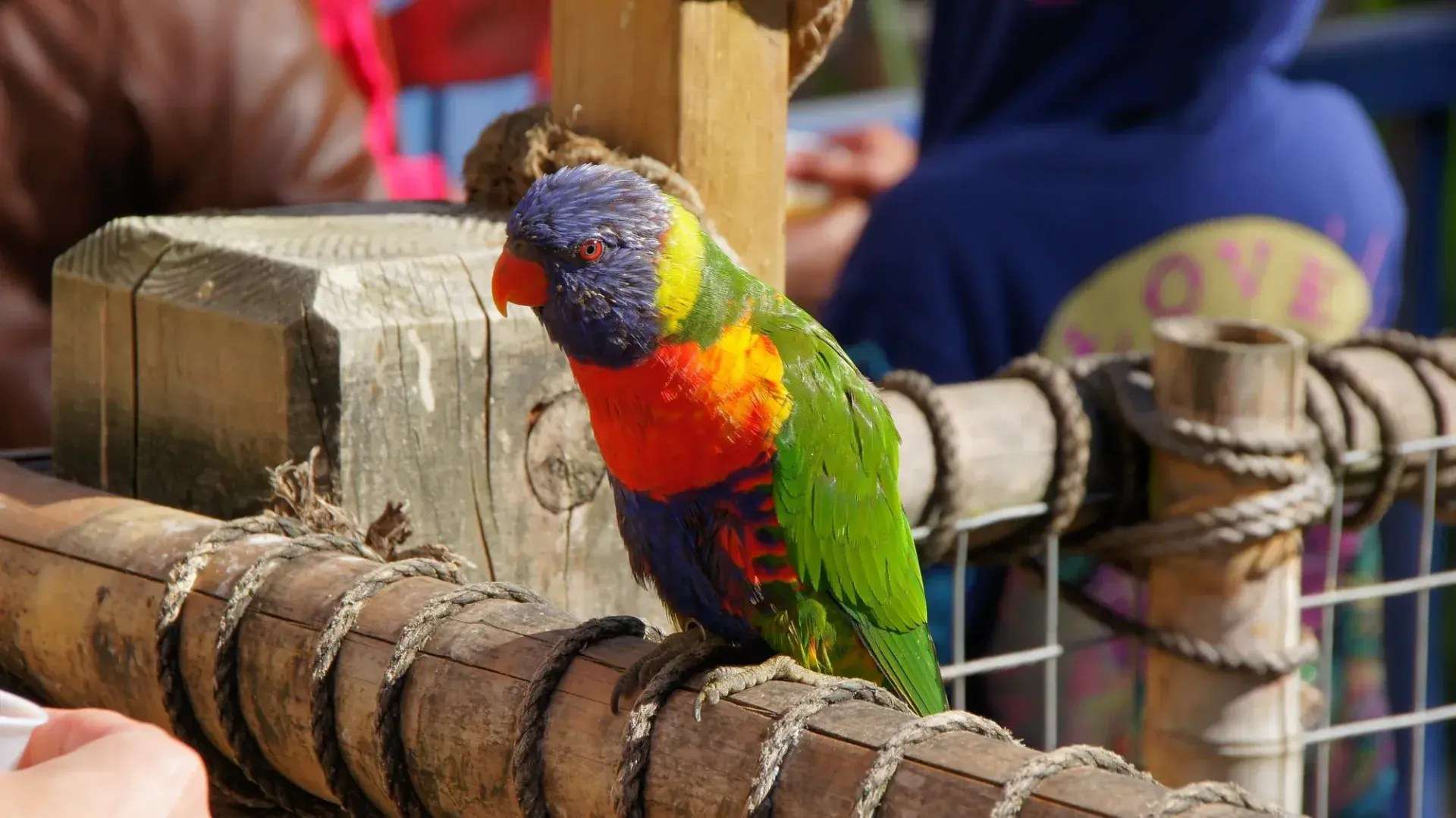
Rainbow Lorikeet
The most colorful parrot most people have ever seen, and one of the loudest, messiest pets they will ever own.
Lifespan
10–15 years
With proper nutrition & care
Size
10–12 inches
75–150 g
Quick Facts
| Size | 10–12 inches |
|---|---|
| Weight | 75–150 g |
| Lifespan | 10–15 years |
| Care level | Advanced |
| Noise level | Loud. Piercing screeches and constant chatter from sunrise to sunset. Not apartment-compatible in any honest sense. |
| Talking ability | Poor. Most never learn clear words; a few pick up 3 or 4 words and household sound mimicry. Not a talking species. |
The Bird
Rainbow Lorikeet at a Glance
The Rainbow Lorikeet is the bird people stop and photograph at zoos. Blue head, green back and wings, orange and yellow chest, royal blue belly: every part of the bird is a different color, and the result is the kind of plumage that doesn't look real until you see it in person. They are 10 to 12 inches long and a slim 75 to 150 grams, smaller than most people expect from the photos.
This is also one of the most common lorikeet species in captivity, both because they breed well and because owners constantly underestimate them and re-home them. A Rainbow Lorikeet on the cover of a bird magazine looks like the perfect pet. A Rainbow Lorikeet in your living room at 6 a.m. is a different conversation. Kalyn is honest with every Rainbow buyer: the color is the easiest part of owning this bird.
Energy is constant, voice is sharp, and the diet is liquid in and liquid out. They are nippy when over-aroused, less reliably cuddly than a Chattering or Dusky Lory, and they need committed daily interaction. The right home for a Rainbow Lorikeet is an experienced lory keeper with a tolerant household, no shared walls, and a wipeable floor. The wrong home is a first-time owner who fell in love with the colors.
Rainbow Lorikeets are extremely energetic and physically expressive. They run laps along perches, swing upside down, drag toys around the cage, and rarely sit still for more than a minute. In a good interactive home this is delightful. In a quiet home where the owner expects a calm shoulder bird, it is exhausting. Plan around the energy or the bird will drive you to distraction.
They are not as reliably cuddly as a Chattering or Dusky Lory. Some Rainbows enjoy head scratches and become genuinely affectionate with their primary person, but the species as a whole is more play-focused than contact-focused. Expect a bird that wants to wrestle a toy in your hand more than one that wants to nuzzle your neck. With consistent socialization most Rainbows become well-behaved in multi-person households, but they can be nippy with strangers and benefit from controlled introductions rather than free access.
The honest behavior reality: Rainbow Lorikeets bite. Not always aggressively, often just explorative or over-aroused beak pressure, but the bites are sharp and they happen during play. Households with young children should plan for adult-supervised interaction only, and adults need to learn the species' over-arousal cues, pinned eyes, raised head, fanned tail, and end the interaction before the beak finds skin.
Vocalization & Talking
Rainbow Lorikeets are loud. The contact call is a sharp, piercing screech that carries through walls and across yards, and the bird uses it dozens of times a day to check in with the household, object to perceived slights, and announce that the sun has come up. Background chatter fills the spaces between screeches. There is no quiet Rainbow Lorikeet.
Talking ability is poor by lory standards. A few birds learn three or four words and a handful of mimicked household sounds. The voice quality is high and not particularly clear, and most Rainbows never develop usable vocabulary. If talking is important to you, a Chattering Lory is a much better choice within the lory family, and an Amazon or African Grey is a much better choice outside it.
Practical reality: this species is not apartment-compatible in any honest sense. Detached single-family homes with tolerant neighbors are the minimum. Aviaries away from the main house are even better.
Diet
Rainbow Lorikeets are obligate nectar feeders. The brush-tipped tongue is built for collecting flower nectar and pollen, and the digestive tract handles a liquid diet, not a dry one. The base of the daily food must be a commercial lory nectar formula such as Lory Life Powder, Higgins inTune Nectar, or Avico Lori Nectar, mixed fresh with clean water at the manufacturer's dilution and offered in dishes that are scrubbed and rinsed every day. Old nectar in a warm room grows bacteria and yeast within hours.
Around the nectar, offer soft fresh foods daily. Papaya, mango, melon, fig, and small amounts of ripe pear and banana are good. Edible flowers from un-sprayed gardens are a major enrichment item: hibiscus, nasturtium, and rose petals all get attacked enthusiastically. Vegetables in smaller quantities are fine: corn, sweet potato, cooked squash, grated carrot. Skip seeds and dry pellets as a main food. They cause long-term digestive issues in this species.
Two specific diet warnings. Iron storage disease is a real concern in Rainbow Lorikeets, so use a low-iron commercial nectar and avoid heavy citrus consumption alongside iron-rich foods. Avocado, chocolate, caffeine, onion, garlic, and salt are toxic to all parrots and Rainbows are no exception. The liquid diet also means liquid droppings, projectile and frequent. Plan the cage area accordingly: tile or vinyl floor, plexiglass splash guard, easy wipe-down access.
Health & Lifespan
A well-kept Rainbow Lorikeet lives 10 to 15 years, sometimes longer with strong husbandry. This is shorter than most parrot species in the size class, and a major reason is diet failure. Birds fed seed mixes or generic pellets rarely make it past 8. Find a board-certified avian vet through the Association of Avian Veterinarians directory in the first month and book annual wellness exams with baseline bloodwork every two to three years.
The two big health risks are iron storage disease (haemochromatosis), which builds slowly on a high-iron diet and shows up as breathing trouble or sudden death, and fungal infections, which take hold fast when cages are not cleaned daily because liquid droppings are a perfect medium for Aspergillus and Candida. Both are husbandry-controlled. Daily cleaning and the right nectar formula prevent the vast majority of cases.
Housing
Minimum cage dimensions are 36"W x 24"D x 24"H with bar spacing no wider than 5/8". Rainbow Lorikeets need horizontal space for play more than height, and a long flight-style cage suits the species better than a tall narrow one. A pair or aviary setup at 48"W or wider is a noticeable upgrade.
Equip with several perches of varied diameter, a stainless steel water bottle backed by an open dish, and an aggressive rotation of foraging toys, swings, and shreddable wood. The species destroys toys faster than most parrots, so budget for weekly replacements. Cage placement matters: tile or vinyl floor only, splash guards on at least the back wall, and away from doorways where projectile droppings can ambush passers-by. Plan on 3 to 4 hours of out-of-cage time daily, supervised, with a dedicated mess-friendly playstand.


Frequently Asked Questions
- Are Rainbow Lorikeets good for beginners?
No. The combination of liquid diet, daily mess, sharp noise, high energy, and nippy play makes them an advanced species. First-time owners do much better with a Cockatiel, Green-Cheeked Conure, or Pionus while they learn parrot keeping basics.
- Can a Rainbow Lorikeet learn to talk?
Most can't, or pick up only 3 or 4 unclear words. The species has a talking score of 3 out of 10. If you want a talking lory, a Chattering Lory is dramatically better. If you want a talking parrot in general, look at African Greys, Amazons, or Quakers instead.
- How often do I need to clean a Rainbow Lorikeet's cage?
Daily. The liquid diet produces liquid droppings that splatter the cage and surrounding walls, and warm liquid waste grows bacteria and yeast within hours. Daily wipe-down of perches, dishes, and splash guards is mandatory, with a deeper weekly clean.
- Will a Rainbow Lorikeet bond to me?
Probably yes to one person, with reservations. Most Rainbows form a clear preference for the primary handler and will be cooperative or playful with that person. They are less reliably cuddly than Chattering or Dusky Lories, expect more play wrestling than nuzzling.
- Can I keep two Rainbow Lorikeets together?
Yes, often very successfully. A bonded pair entertain each other, breed readily under the right conditions, and can be a better fit than a single bird if the owner cannot provide several hours of daily interaction. Be aware that paired birds often bond more to each other than to people.